 Heltebog

What exhaustion does
Exhaustion is a condition that stacks. Each time something exhausts you, you gain a level of exhaustion, and the penalty grows with it:
- Every ability check, attack roll and saving throw is reduced by 2 × your exhaustion level. Initiative counts, since it's a Dexterity check, and so do death saving throws.
- Your speed drops by 5 feet per level.
- At level 6 the character dies.
Nothing else changes. You keep your hit points, you can still cast spells, and exhaustion never gives you disadvantage. Your armour class and spell save DC stay the same too, because they aren't rolls.
- 0±030 ftRested
- 1−225 ft
- 2−420 ft
- 3−615 ft
- 4−810 ft
- 5−105 ft
- 6†Dead
Each long rest: one level less
Based on a speed of 30 feet.
A worked example
A rogue with +8 in Stealth has picked up three levels of exhaustion on a long march through the marshes. Three levels means −6. She rolls a 12 to sneak past the guards, so the result is 12 + 8 − 6 = 14. Her speed of 30 feet is down to 15.
One more level and the penalty would be −8, with 10 feet of movement left.
The 2014 rules worked differently
If your table still plays by the 2014 rules (SRD 5.1), exhaustion has a different effect at each of its six levels, and the effects add up:
- Disadvantage on ability checks
- Speed halved
- Disadvantage on attack rolls and saving throws
- Hit point maximum halved
- Speed reduced to 0
- Death
Under those rules a long rest removes a level only if the character has also had food and drink. The 2024 rules replaced the table with a single penalty that grows with each level. Check with your game master which version your table uses.
2024 rules
- −2 per level on every d20 roll
- −5 feet of speed per level
- Level 6: death
- Long rest: one level less
2014 rules
- 1: disadvantage on ability checks
- 2: speed halved
- 3: disadvantage on attacks and saves
- 4: hit point maximum halved
- 5: speed 0
- 6: death
- Long rest: one level less, with food and drink
How you get it, and how you lose it
The game master decides when you gain exhaustion. In the rules, it comes from things like going without food or water, running out of breath, and certain spells and monsters. Each of those says how many levels you gain.
Every long rest you finish removes one level. The spell Greater Restoration also removes a level, while Lesser Restoration does nothing for it. When the level reaches 0, the condition ends.
Keeping track in Heltebog
I made Heltebog so the sheet does this kind of sum for you. Open Conditions on the hero's combat page and set exhaustion anywhere from 0 to 6. Every roll made from the sheet then has the penalty subtracted: ability checks, saves, skills, attacks, initiative and death saves. The speed at the top of the sheet drops to match, and a long rest takes one level away. Under the list there's a page that says what each condition does, with the ones in play first.
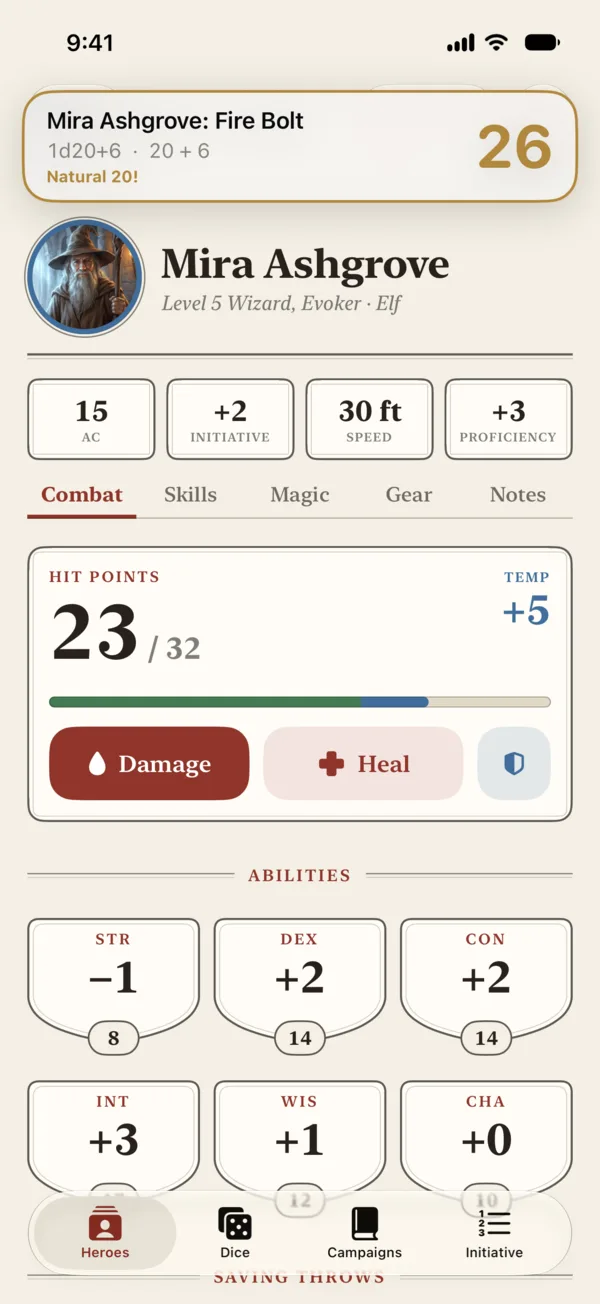
- The speed at the top of the sheet drops by 5 feet per level.
- Step exhaustion up or down, from 0 to 6.
- The sheet says what the level costs right now.
- What every condition does, the ones in play first.
Heltebog costs $2.99, once. There's no subscription and no account, and the hero stays on your iPhone.
 The proficiency bonus, level by level